En esta Situación de Aprendizaje vamos a aprender a realizar una Lectura de una imagen. ¿Pero las imágenes se leen? Sí, se leen. Y si realmente queremos disfrutar de las imágenes, debemos aprender a «Leerlas»
Tal y como vimos anteriormente en el tema de La Comunicación Visual las imágenes tienes dos posibles descripciones, una denotativa (objetiva) y otra connotativa (subjetiva), y ambas configuran el análisis de una imagen.
Vamos a ver cómo realizarlo paso a paso. //
In this Learning Situation, we are going to learn how to read an image. But… can the images be read? Yes, they are read. And if we really want to enjoy images, we must learn to «read them.»
As we saw previously in the topic of Visual Communication, images have two possible descriptions, one denotative (objective) and the other connotative (subjective), and both configure the analysis of an image.
Let’s see how to do it step by step.
Comencemos con la Lectura Denotativa (u objetiva)://
Let’s start with the Denotative (or objective) Reading:
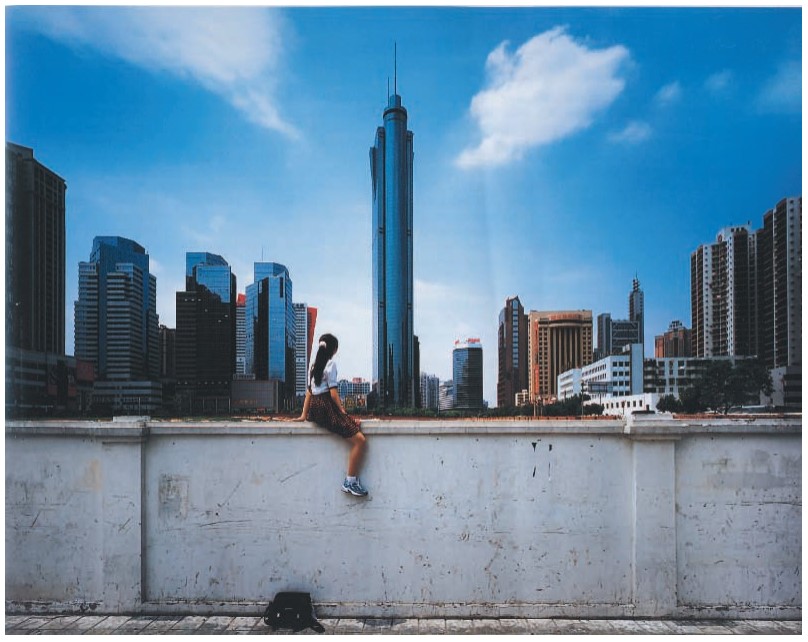
- Contemplación: por increíble que parezca, no basta con ver una imagen. Hay que contemplarla. Si nos fijamos en la fotografía, en un primer vistazo vemos una escena exterior de una cuidad con un personaje sentado sobre un muro. Si la contemplamos, nos damos cuenta que el personaje es una niña, que ha dejado atrás una mochila al subirse al muro y contempla unos rascacielos no muy habituales en nuestras ciudades.
- // Contemplation: as incredible as it may seem, it is not enough to see an image. You have to contemplate it. If we look at the photograph, at first glance we see an exterior scene of a city with a character sitting on a wall. If we look at it, we realize that the character is a girl, who has left a backpack behind when climbing the wall and is contemplating some skyscrapers that are not very common in our cities.
- Identificación: del autor, de su trayectoria, del título de la obra, la técnica utilizada y el año de realización, así como su localización y dimensiones. Es decir, la ficha técnica, los datos en crudo. Siguiendo con la misma imagen, el autor es Weng Fen, y es una fotografía de la ciudad de Guangzhou realizada en 2002, desde una azotea.
- // Identification: of the author, his career, the title of the work, the technique used and the year of completion, as well as its location and dimensions. That is, the technical sheet, the raw data. Continuing with the same image, the author is Weng Fen, and it is a photograph of the city of Guangzhou taken in 2002, from a rooftop.
- Clasificación de la Imagen: consiste en determinar las características del soporte (diferenciando si es bidimensional o tridimensional, si es una imagen fija o en movimiento), su grado de iconicidad (su parecido a la Realidad) y su Función (si es Artística, Informativa, o Exhortativa) La obra de Weng Fen es una imagen fija, bidimensioanl con un alto grado de iconicidad y con función Artística.
- // Image Classification: consists of determining the characteristics of the support (differentiating whether it is two-dimensional or three-dimensional, whether it is a fixed or moving image), its degree of iconicity (its resemblance to Reality) and its Function (if it is Artistic, Informative , or Exhortative) Weng Fen’s work is a fixed, two-dimensional image with a high degree of iconicity and artistic function.
- Descripción: consiste en describir todo lo que aparece en la imagen, incluyendo la acción y el espacio donde se desarrolla (si lo hubiera) sin hacer valoraciones. En la imagen anterior vemos un muro que ocupa el tercio inferior de la imagen, una niña con uniforme de colegio sobre él, la mochila en el suelo de una azotea y modernos edificios al fondo en un paisaje urbano en un día soleado con algunas nubes que ocupa los dos tercios superiores de la imagen
- // Description: consists of describing everything that appears in the image, including the action and the space where it takes place (if any) without making evaluations. In the previous image we see a wall that occupies the lower third of the image, a girl with a school uniform on it, the backpack on the floor of a rooftop and modern buildings in the background in an urban landscape with a sunny day with some clouds which occupies the upper two thirds of the image
A partir de aquí tendríamos que hacer el análisis subjetivo de la imagen, o Lectura Connotativa:
// From here we would have to do the subjective analysis of the image, or Connotative Reading:
- Análisis Iconográfico: // Iconographic Analysis:
- Elemento de significación: se trata de descubrir el elemento clave que nos lleva a entender el significado de la imagen. En este caso es la niña sobre el muro
- // Element of significance: it is about discovering the key element that leads us to understand the meaning of the image. In this case it is the girl on the wall
- Elementos narrativos: consiste en describir los significados individuales de cada elemento de la imagen. La niña es el personaje principal de la imagen, y salvo la mochila, el resto son elementos arquitectónicos (muro de azotea y edificios modernos)
- // Narrative elements: consists of describing the individual meanings of each element of the image. The girl is the main character of the image, and except for the backpack, the rest are architectural elements (roof wall and modern buildings)
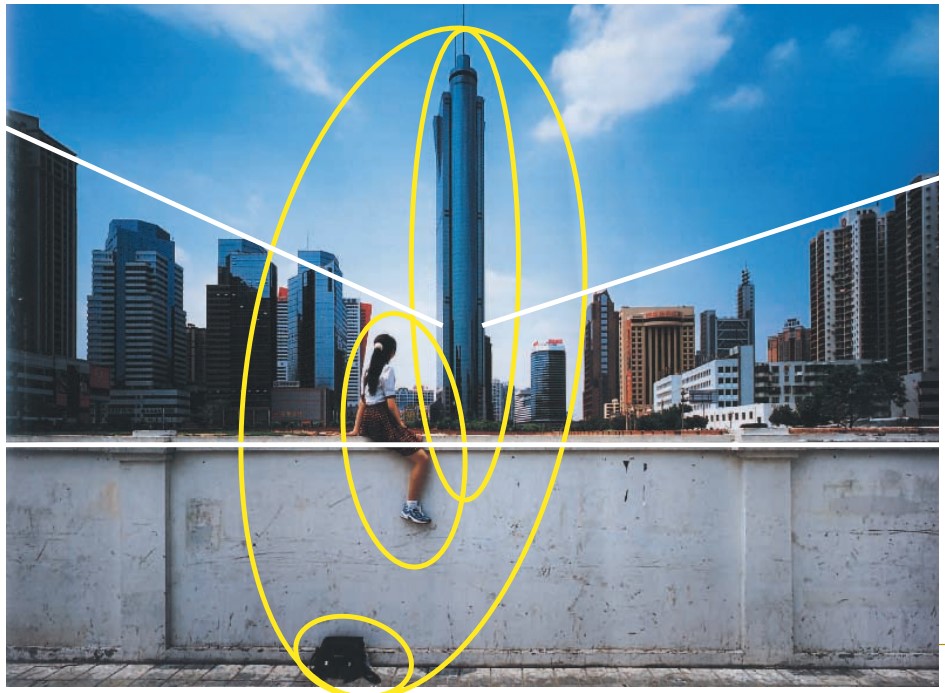
- Herramientas del lenguaje visual: se trata de definir las características que presentan las formas, colores, texturas y organización espacial de la imagen. La fotografía esta tomada desde un punto medio (frontal) con una visión de conjunto mediante un gran plano general. Así, la perspectiva de los edificios nos señala el centro de interés visual, que está compuesto por la niña, el edificio central y la mochila. El color prioritariamente frío refuerza la sensación de ciudad joven y en crecimiento, ya que los tonos son azulados se pueden asociar a algo nuevo, por estrenar, al tiempo, que marca la distancia con respecto a la chica (tonos cálidos). La luz diurna sobre el muro separa al personaje de la escena aumentando la sensación de observación. La niña aparece de espaldas, sentada y observando
- // Visual language tools: it is about defining the characteristics presented by the shapes, colors, textures and spatial organization of the image. The photograph is taken from a midpoint (Eye level Shoot) with an overall view through a long shot. Thus, the perspective of the buildings shows us the center of visual interest, which is made up of the girl, the central building and the backpack. The primarily cold color reinforces the feeling of a young and growing city, since the blue tones can be associated with something new, brand new, at the same time, marking the distance with respect to the girl (warm range). The daylight on the wall separates the character from the scene, increasing the sensation of observation. The girl appears from behind, sitting and observing
- Elemento de significación: se trata de descubrir el elemento clave que nos lleva a entender el significado de la imagen. En este caso es la niña sobre el muro
- Interpretación: conclusión // Interpretation: conclusion
- Significado: consiste en reorganizar la información hasta aquí obtenida para describir el mensaje implicito de la imagen. Este mensaje es la verdadera información recibida, y no es visible en un principio. Es la historia que nos cuenta, o la que interpretamos subjetivamente a partir de nuestra experiencia y conocimientos. Tras hacer el recorrido visual se deduce que la niña ha salido del colegio ha llegado a la azotea de un edificio y, tras dejar la mochila en el suelo, se ha sentado en el muro para contemplar la panorámica de la ciudad donde reside. La niña puede ser un elemento simbólico del futuro que crece junto a la ciudad y que ahora son testigos pero que en el futuro formarán parte de él.
- // Meaning: it consists of reorganizing the information obtained up to this point to describe the implicit message of the image. This message is the true information received, and is not visible at first. It is the story that tells us, or the one that we subjectively interpret based on our experience and knowledge. After taking the visual tour, it is deduced that the girl has left school, arrived at the roof of a building and, after leaving her backpack on the ground, she has sat on the wall to contemplate the panoramic view of the city where she lives. The girl can be a symbolic element of the future that grows together with the city and that they are witnesses now but that in the future they will be part of it.
- Significado: consiste en reorganizar la información hasta aquí obtenida para describir el mensaje implicito de la imagen. Este mensaje es la verdadera información recibida, y no es visible en un principio. Es la historia que nos cuenta, o la que interpretamos subjetivamente a partir de nuestra experiencia y conocimientos. Tras hacer el recorrido visual se deduce que la niña ha salido del colegio ha llegado a la azotea de un edificio y, tras dejar la mochila en el suelo, se ha sentado en el muro para contemplar la panorámica de la ciudad donde reside. La niña puede ser un elemento simbólico del futuro que crece junto a la ciudad y que ahora son testigos pero que en el futuro formarán parte de él.
Créditos// Credits: Los lenguajes Visuales McGraw Hill // Translation by Google translator
Si deseas ampliar información puedes visitar este enlace de Tavernescav2 (con ejemplos muy pormenorizados)
Actividad:
En esta actividad, tendrás que preparar una presentación sobre una obra de alguno de los siguientes artistas y exponerla en clase.
SdA Análisis de una obra de arte
Elige uno/a de los/las siguientes autores/as:
Sofonisba Anguissola (1535-1625)
Clara Peeters o Clara Lamberts (fechas sin confirmar 1594-1657)
Artemisia Gentileschi (1593 – 1653)
Berthe Morisot (1841-1895)
Hilma af Klint (1862-1944)
Camille Claudel (1864-1943)
Sonia Delaunay (1885-1979)
Natalia Goncharova (1881-1962)
Georgia O´Keeffe (1887-1986)
Liubov Popova (1889 – 1924)
Tamara de Lempicka (1898-1980)
Frida Kahlo (1907-1954)
Louise Bourgeois (1911-2010)
Helen Frankenthaler (1928-2011)
Yayoi Kusama (1929-)
Carmen Laffón (1934 – 2021)
Esther Ferrer (1937-)
Ana Mendieta (1948-1985)
Zaha Hadid (1950-2016)
Cristina Iglesias (1956-)
Leonardo da Vinci (1452 -1519)
Miguel Ángel Buonarroti (1475-1564)
Rafael Sanzio (1483-1520)
Caravaggio (1571 -1610)
El Greco (1541-1614)
Rembrandt van Rijn (1606- 1669)
Diego Velázquez (1599 – 1660)
Peter Paul Rubens (1577 -1640)
Claude Monet (1840-1926)
Auguste Rodin (1840-1917)
Vincent van Gogh (1853- 1890)
Edvard Munch (1863-1944)
Pablo Picasso (1881- 1973)
Salvador Dalí (1904 – 1989)
Jackson Pollock (1912-1965)
Andy Warhol (1928-1987)
Constantin Brancusi (1876-1957)
Alexander Calder (1898-1976)
Henry Moore (1898-1986)
Alberto Giacometti (1901-1966)
Banksy (Desconocido)
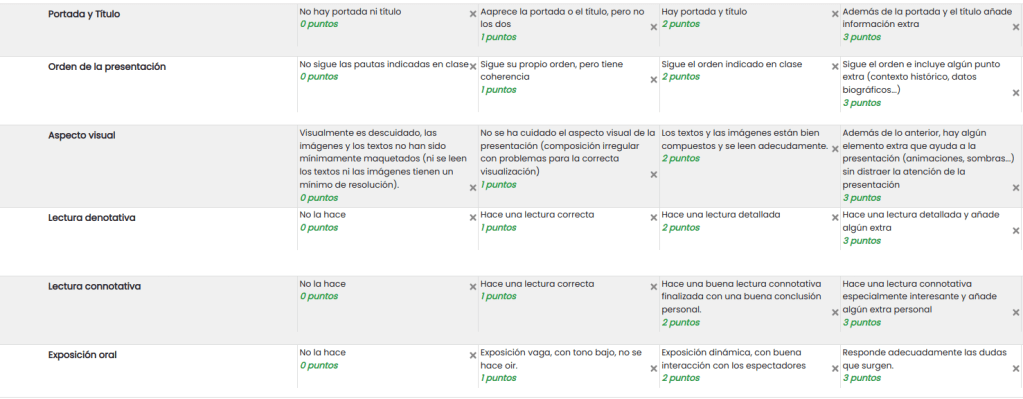
Una vez tengas el nombre, debes buscar una obra suya que te haya llamado la atención y realizar la lectura denotativa y connotativa de esa obra tal y como hemos estudiado. Cuando tengas toda la información deberás realizar una pequeña presentación (digital y/o analógica) donde expongas al resto de la clase tu trabajo.
Presentación de ejemplo «Los burgueses de Calais» de Rodin
Rúbrica de la Actividad:

 Plasticavite.com
3 comentarios sobre “Cómo «leer» una imagen // How to «read» an image”