
1. DIBUJO TÉCNICO: TRAZADOS GEOMÉTRICOS.//
1. TECHNICAL DRAWING: GEOMETRIC DRAWINGS
1.1. ÚTILES Y MATERIALES DE DIBUJO TÉCNICO:
1.1. USEFUL AND TECHNICAL DRAWING MATERIALS:
FORMATOS NORMALIZADOS DE PAPEL:
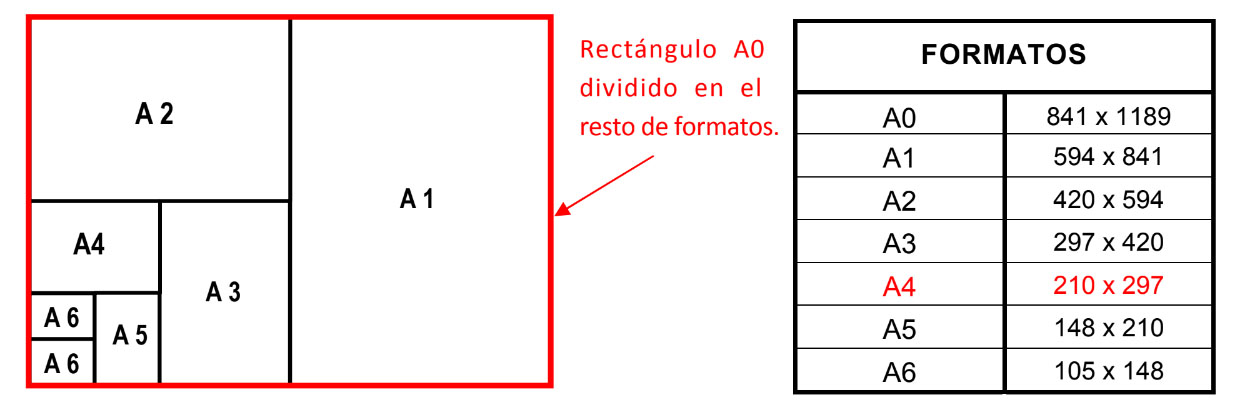
En el dibujo técnico el tamaño del papel está establecido por una norma internacional. A partir de un rectángulo de papel de 1m2 de superficie (llamado formato A0), se obtienen el resto de tamaños, dividiendo el papel por la mitad. Así pues, un A4 es la mitad de un A3, por ejemplo.
NORMALIZED PAPER FORMATS:
In technical drawing the paper size is established by an international standard. From a paper rectangle of 1m2 of surface (called A0 format), the other sizes are obtained, dividing the paper in half. For instance, an A4 is half size of an A3 format.
LÁPIZ DE GRAFITO:
Está formado por una “mina” o barra de mineral de grafito mezclado con arcilla, que va protegida por una cubierta de madera. Dependiendo del porcentaje de grafito o arcilla, tendremos una mina “blanda” (grasa, de trazo oscuro) o “dura” (seca, de trazo gris).
El lápiz de grafito va numerado para indicar su grado de dureza. La numeración escolar americana, de origen francés, es sencilla pero limitada (0, 1, 2, 2 ́5, 3, 4). La europea, de origen inglés (que es la que nos interesa), tiene 20 números que van del gris claro al negro. Se utiliza la letra » H» (“hard”, duro en inglés) para señalar los lápices duros y la » B» (“black”, negro en inglés) para lápices blandos. Tal vez puedas encontrar en el mercado algún lápiz también marcado «F» («Fino», entre HB y H)

GRAPHITE PENCIL
It is formed by a bar of graphite ore mixed with clay, which is protected by a wooden case. It depend on the percentage of graphite or clay, we will have a “soft” (grease, dark line) or “hard” (dry, gray line) mine.
The graphite pencil has a number code to indicate its degree of hardness. American school numbering, of French origin, is simple but limited (0, 1, 2, 2’5, 3, 4). The European, of English origin (which is what interests us), has 20 steps from light gray to black. The letter «H» («hard») is used to indicate hard pencils and «B» («black») for soft pencils. Maybe you can find in market some pencil also marked «F» («Fine», between HB and H)
Además de estas dos numeraciones, algunos lápices llevan en su extremo un código de color para reconocerlo con facilidad (rojo, azul, negro, verde, etc.). Ejemplo, nuestro querido lápiz HB:
In addition to these two numbers, some pencils have at their end a color code to recognize it easily (red, blue, black, green, etc.). For example, the most usefull, our lovely HB pencil

LA ESCUADRA Y EL CARTABÓN:
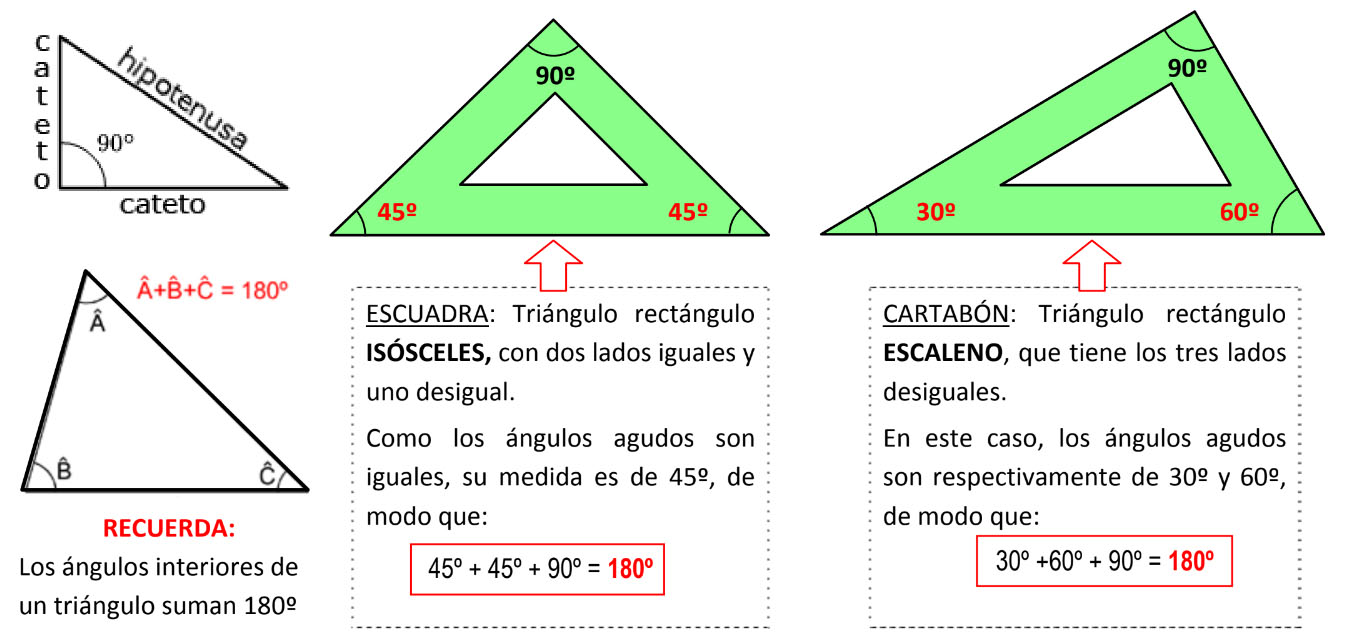
Son dos instrumentos de dibujo con forma de triángulo rectángulo.
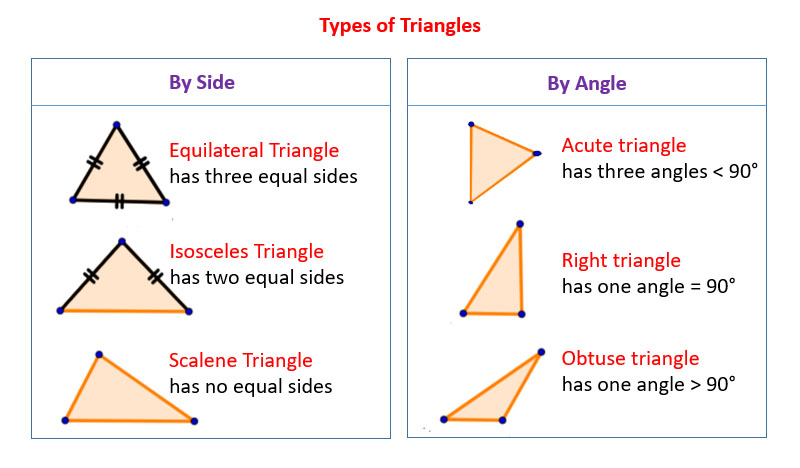
Recuerda que puedes reconocer un triángulo por sus lados o por sus ángulos
THE SQUARE AND THE CARTABON:
They are two drawing instruments shaped like a right triangle.
Remember that you can recognice a triangle by their sides or by their angles
LOS TRIÁNGULOS RECTÁNGULOS: Tienen un ángulo recto y dos agudos. Los lados que forman 90º se llaman “catetos” (cateto significa perpendicular) y el lado restante (lado mayor) se llama “hipotenusa”. La hipotenusa es, por tanto, el lado opuesto al ángulo de 90º
RIGHT TRIANGLES: They have a right angle and two acute. The sides that form 90º are called «legs» (leg means perpendicular) and the remaining side (the big one) is called «hypotenuse.» The hypotenuse is, therefore, the opposite side of the 90º angle (Remember: the sum of the angles in a triangle is 180 degrees)
¡Quieto parao!
¿Aún no sabes qué es un punto o una línea? ¿Paralelas, perpendiculares?… Ufff, casi nos pasamos. Te dejo algo de teoría básica sobre
Elementos Geométricos
¿Qué es un punto?
El punto es la mínima unidad geométrica. No tiene longitud, ni profundidad, ni anchura. Esto quiere decir que un punto simplemente designa una posición y, por definición, no existen puntos grandes ni pequeños. Se nombran con letra mayúscula y se puede representar con distintos tipos de signos. Los más habituales son un pequeño círculo, un punto y una pequeña cruz en forma de X o aspa.//
What is a point?
A point is the smallest geometric unit. It has no length, depth, or width.

This means that a point simply designates a position, and there are no big, small, or fat points.

They are designated with capital letters and can be represented with different types of symbols. The most common are a small circle, a dot, and a small cross in the shape of an X or a cross.
Y ahora… ¿Qué es una Línea?
Una línea no es más que una sucesión de puntos, o un punto en movimiento. Paul Klee dijo que «la línea es un punto que se fue de vieje»
Tipos:
Línea recta.
La línea recta es una sucesión de puntos con una dirección fija.
Línea curva.
La línea curva sucesión de puntos con una dirección variable. Se pueden clasificar como abiertas o cerradas.
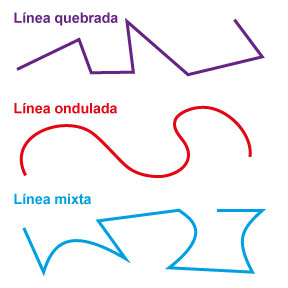
Otras líneas:
A line is a succession of points, or a point in motion. Paul Klee said, "A line is a point gone on an adventure."

Types:

Straight line.

A straight line is a succession of points with a fixed direction.

Curved line.

A curved line is a succession of points with a variable direction. They can be classified as open or closed.
Others lines:
Broken line
Mixed line
Wavy line
Semirrecta.
Una semirrecta es una línea recta que tiene principio, pero no tiene fin. Es una recta limitada en uno de sus extremos.
Segmento.
Un segmento es una línea recta con principio y fin. Una porción de recta limitada por dos puntos.
Ray.
A ray is a straight line that has a beginning but no end. It is a line limited at one of its endpoints. It is determined by naming the point with a capital letter and the line with a lowercase letter.

Segment.
A segment is a straight line with a beginning and an end. A portion of a line limited by two points. It can be named in two ways: with the letters of its endpoints (AB) or with a lowercase letter.
Posiciones relativas entre rectas.
Dos o más rectas pueden relacionarse entre si según sus posiciones:
- Paralelas: Se dice que dos rectas son paralelas si siempre se mantienen a una misma distancia entre si, y nunca se llegan a cortar.
- Perpendiculares: Se dice que dos rectas son perpendiculares cuando al cortarse forman 4 ángulos rectos (90 grados).
- Secantes: Dos rectas son secantes cuando al se cortan formando ángulos distintos al ángulo recto.

Relative positions between lines.

Two or more lines can be related to each other according to their positions:

Parallel: Two lines are said to be parallel if they always remain at the same distance from each other and never intersect.
Perpendicular: Two lines are said to be perpendicular when they intersect and form four right angles (90 degrees).
Intersecting: Two lines are intersecting when they intersect at angles other than a right angle.
Ahora vamos a practicar el trazado de paralelas y perpendiculares con escuadra y cartabón.
Drawing paralells and perpendicular lines with square and cartabon
Margen y Cajetín para láminas de este curso
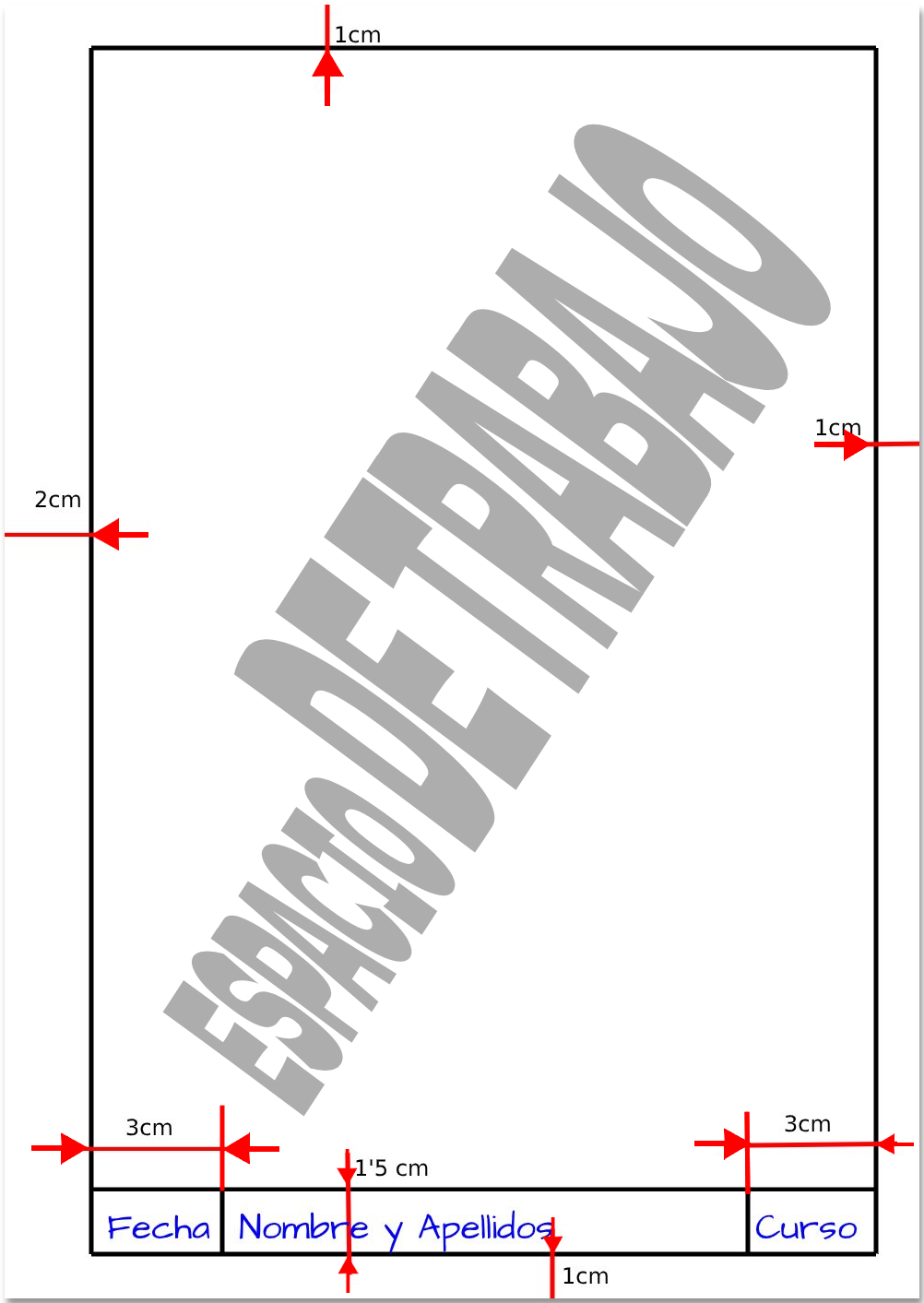
Si alguien quiere empezar a trabajar más «en serio» es recomendable que visite este enlace de lamonalista.com
Créditos:
-
https://sites.google.com/site/dibujovistazul/Home/epv-de-1o-de-eso
-
Paula Peña – Tutoriales
-
Wikipedia
-
https://mymodernmet.com/es/los-mejores-lapices-de-dibujo/
-
HTTPS://EDUCACIONPLASTICAYVISUAL.COM/DIBUJO-TECNICO/ELEMENTOS-GEOMETRICOS-BASICOS/
Y ahora, para comprobar que has entendido todo lo explicado, vamos a hacer una Autoevaluación
En muchas ocasiones utilizo esta entrada para diferentes cursos, posteriormente, cada curso realiza su lámina correspondiente, si quieres ver ejemplos concretos sigue este enlace

 Plasticavite.com